
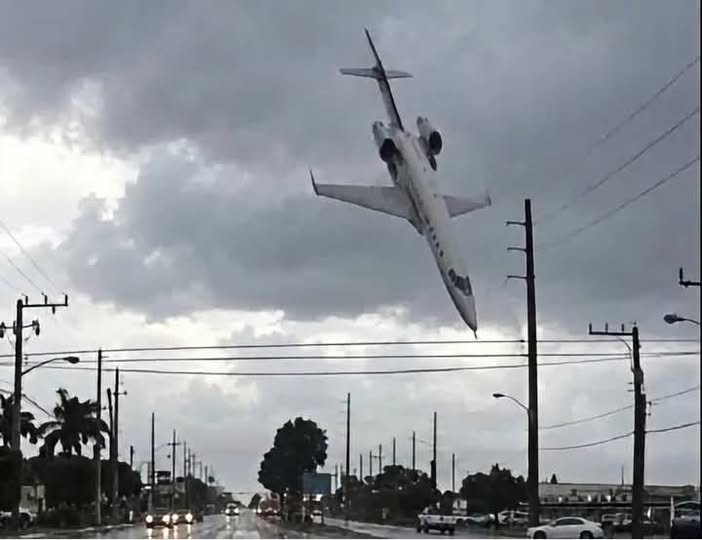
A private Learjet 60 has crashed into a residential neighbourhood in Greenacres, Palm Beach County, Florida, on Sunday, November 1, killing all nine people reportedly aboard and leaving the aircraft shattered across the impact site.
The aircraft, identified by its registration number N722BD, was travelling from Austin-Bergstrom International Airport in Texas to North Eleuthera Airport in the Bahamas when it crashed near South Military Trail, between Cresthaven Boulevard and 10th Avenue North.
The crash triggered a massive fireball, scattered wreckage across the area and damaged nearby property, prompting an emergency response from firefighters, law enforcement officers and other rescue personnel.
Videos circulating on social media showed debris scattered around the crash site, with little of the aircraft’s main structure left recognisable.
Flight-tracking data indicated that the aircraft had climbed to approximately 41,000 feet before its flight path changed dramatically.
Preliminary tracking reports suggested the jet entered an exceptionally steep descent, with some data indicating a vertical descent rate exceeding 32,000 feet per minute.
Analysis cited by CNN reportedly showed the aircraft losing approximately 27,000 feet in altitude within a minute before its tracking signal disappeared.
However, the available figures vary, and investigators have yet to establish the precise circumstances surrounding the aircraft’s final moments.
The aircraft’s reported descent has raised questions about how a jet of its size could break apart so extensively upon impact.
The extensive destruction can be explained, in part, by the enormous forces generated when an aircraft strikes the ground at high speed.
The Learjet 60 is approximately 58 feet long, with a wingspan of about 44 feet. Its structure incorporates lightweight materials designed to withstand the stresses of normal flight, not the extreme forces associated with a high-speed ground impact.
During such a collision, the aircraft’s kinetic energy is released over an extremely short period. The resulting forces can rupture the fuselage, separate the wings, destroy the engines and scatter fragments over a wide area.
The impact can also drive debris into the ground, leaving a crater at the crash site. If aviation fuel ignites, the resulting fire can cause further damage to the wreckage.
These factors help explain why a severely damaged aircraft may leave few recognisable sections after a catastrophic crash. However, the precise sequence of events in this incident has not been established.
Witnesses reported a deafening explosion as the aircraft came down near a mobile home community.
Preliminary accounts indicated that the jet struck a tree and brought down power lines before crashing into or near a mobile home. At least one residence was reportedly destroyed, while nearby residents experienced power outages.
Emergency crews rushed to the scene as thick smoke rose above the neighbourhood. Firefighters worked to contain the flames while authorities secured the surrounding area.
Palm Beach County Fire Rescue reportedly treated the incident as a mass-casualty emergency.
Although reports indicated that all nine people aboard the aircraft died, authorities had not established a definitive official death toll at the time of the available reports. Information about possible casualties on the ground also remained unclear.
The crash site was approximately six to eight miles from President Donald Trump’s Mar-a-Lago estate in Palm Beach.
CNN reported that Trump had been in West Palm Beach earlier on Sunday and departed aboard Air Force One about an hour before the incident.
There was no evidence linking the aircraft’s proximity to the estate to the cause of the crash.
Federal Aviation Administration registration records reportedly identify LR60271 LLC, a company based in Wilmington, Delaware, as the aircraft’s registered owner.
Aurora Aviation was mentioned in preliminary online reports as a possible charter operator, but that information had not been independently confirmed.
Thunderstorms were also reported in the wider region around the time of the incident. Investigators have yet to determine whether weather conditions contributed to the crash.
The Federal Aviation Administration and the National Transportation Safety Board are expected to examine the circumstances surrounding the crash, with the NTSB leading the investigation.
Investigators will analyse available flight-tracking information, examine recovered wreckage, review aircraft maintenance records and assess weather conditions to determine what caused the jet’s sudden descent.
Authorities will also work to establish the aircraft’s final flight path and reconstruct the sequence of events leading to impact.
The identities of those aboard had not been publicly released in the available reports.