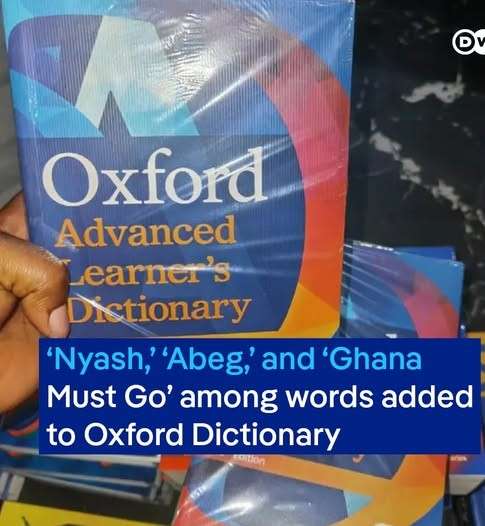
From street slang to cultural staples, Nigerian and West African expressions have secured formal recognition on the global stage, with the Oxford English Dictionary (OED) adding 24 new words drawn from everyday life across the region.
The latest update, announced by the OED on X, reflects the growing global influence of Nigerian and West African English, shaped by migration, music, food, politics and popular culture. Among the newly admitted entries are widely used terms such as nyash, abeg, biko and Ghana Must Go words long familiar to millions of speakers but now officially codified in one of the world’s most authoritative dictionaries.
According to the OED, abeg is defined as an interjection expressing emotions such as surprise, impatience or disbelief, while biko, derived from the Igbo language, is described as a polite interjection equivalent to “please”.
Nyash is defined as a person’s backside, especially a woman’s, a term popularised through everyday speech, music and social media.
The dictionary also formalised the meaning of Ghana Must Go, referring to the large, chequered plastic bags commonly used across West Africa. The term traces its origins to the 1983 expulsion of Ghanaian migrants from Nigeria, embedding a significant historical moment into everyday language.
In a statement cited by PREMIUM TIMES, the OED confirmed that the new additions were drawn mainly from Nigeria and Ghana—the two largest English-speaking countries in West Africa—as well as from Gambia, Liberia and Sierra Leone. The update underscores the dictionary’s ongoing effort to reflect the evolving nature of English as a global language shaped by diverse cultures.

The Nigerian entries span food, fashion, music, crime, politics and street life. They include culinary staples such as amala, eba, moi moi and suya; cultural markers like gele and adire; and contemporary expressions including japa, agbero, area boy and yahoo or yahoo boy. Also listed are Naija, Afrobeats, 419, abi, mammy market, kobo and cross-carpeting, the latter reflecting Nigeria’s fluid political culture.
Language experts say the inclusion is a recognition of how Nigerian English has travelled beyond national borders through film, music, literature and digital media, influencing global conversations and vocabulary.
With these additions, everyday words once confined to local streets and informal conversations now sit alongside standard English entries, affirming West Africa’s growing imprint on the world’s shared language.