Don advocates performance-based revenue sharing, digital taxation, fiscal discipline as Igbinedion University delivers 28th inaugural lecture
From Moshood Karim
Professor Blessing Ose Oligbi has identified weak fiscal accountability, overdependence on federal allocations, poor revenue generation, mounting public debt and inadequate institutional capacity as major obstacles undermining grassroots development in Nigeria.
The university don called for sweeping reforms in the country’s fiscal federalism, urging the Federal Government, State Governments and local councils to adopt a more productive, transparent and accountable system of managing public resources.
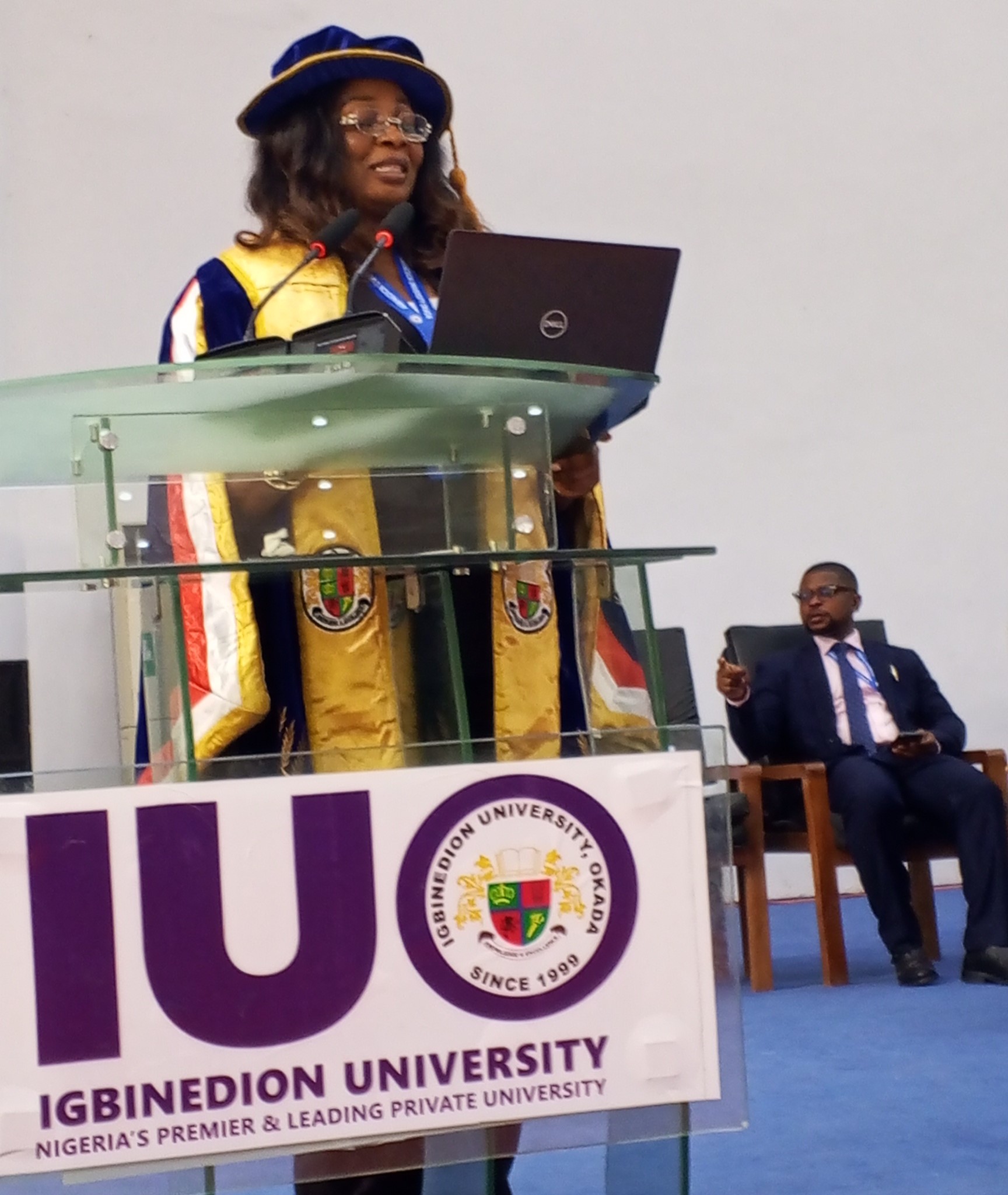
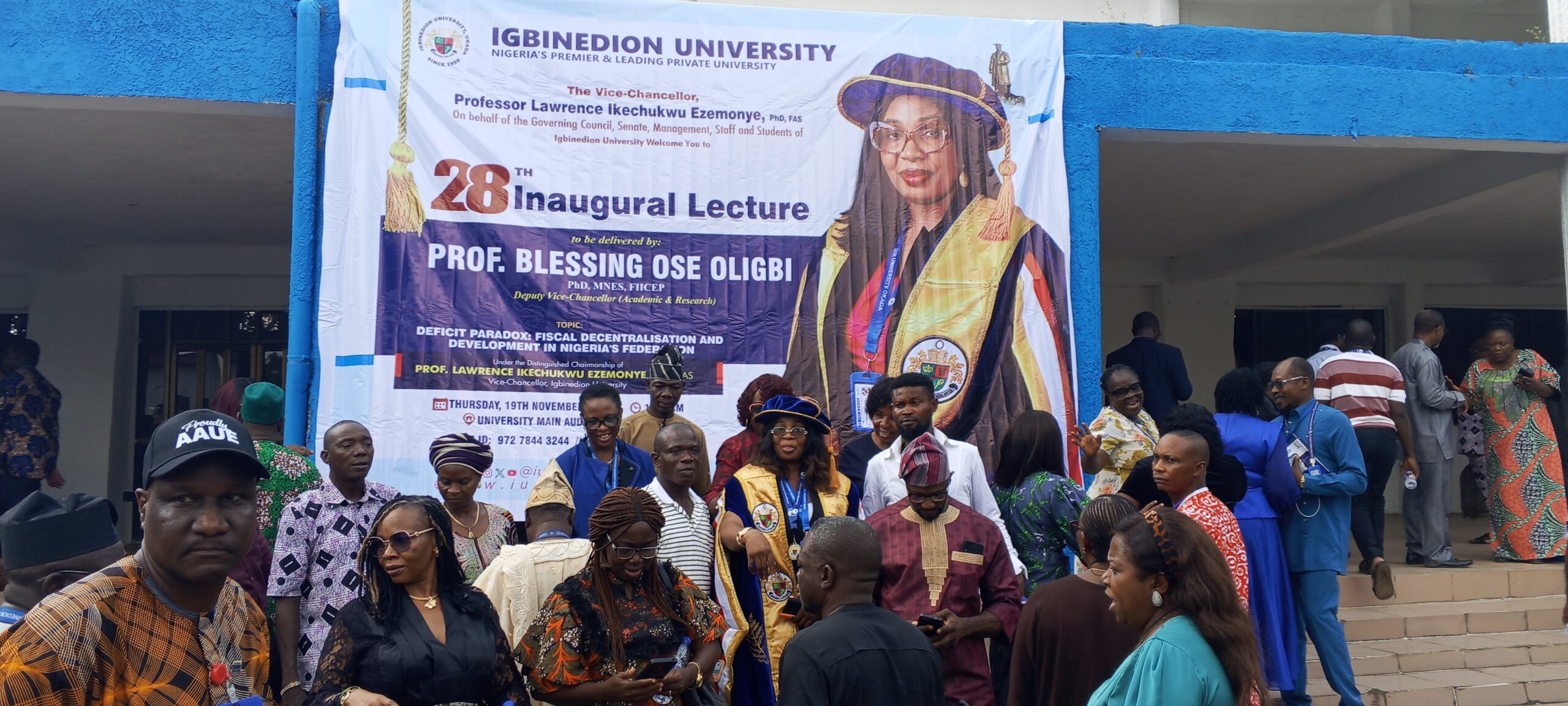
Oligbi made the call on Thursday, November 19, 2026, while delivering the 28th Inaugural Lecture of Igbinedion University, Okada, titled, “The Deficit Paradox: Fiscal Decentralisation and Development in Nigeria’s Federation.”
The lecture was delivered under the chairmanship of the Vice-Chancellor, Professor Lawrence Ikechukwu Ezemonye.
Explaining the central argument of her lecture, Oligbi described Nigeria’s fiscal situation as a Deficit Paradox, where sub-national governments have enormous responsibilities for delivering essential services but lack the financial independence, institutional capacity and accountability mechanisms required to meet those obligations effectively.
She noted that although State and Local Governments are closest to the people and are expected to provide primary healthcare, basic education, local roads and other critical infrastructure, their heavy dependence on federal allocations has weakened their ability to deliver meaningful development.
According to her, the problem is not fiscal decentralisation itself but the institutional arrangements governing revenue generation, expenditure responsibilities, borrowing and accountability.
She identified three interconnected dimensions of the Deficit Paradox: fiscal deficit, arising when governments spend beyond their internally generated revenue and depend on transfers and borrowing; service deficit, where public expenditure fails to produce corresponding improvements in essential services; and accountability deficit, characterised by weak connections between taxation, government budgets and citizens’ oversight.
The professor identified several structural and institutional challenges responsible for Nigeria’s poor fiscal outcomes.
Among them are the concentration of high-yield revenue sources at the federal level while States and local governments shoulder substantial expenditure responsibilities; unequal revenue-generating capacities among states; excessive dependence on Federation Account allocations; and weak incentives for sub-national governments to expand their internally generated revenue.
She also highlighted soft budget constraints, explaining that governments expecting financial rescues from the centre may overspend, neglect revenue generation and accumulate unsustainable debts.
Other challenges include political interference and weak accountability, inadequate capacity for budgeting, auditing, procurement and project execution, as well as the diversion of resources towards recurrent expenditure at the expense of capital projects.
Oligbi further observed that resource rents weaken the incentive to develop other sources of revenue, while debt servicing and recurrent financial obligations continue to constrain investments in infrastructure and essential public services.
On local government autonomy, she recalled the Supreme Court judgment of July 11, 2024, which directed that allocations meant for local governments should be paid directly to democratically elected councils.
However, she noted that reports during 2026 indicated that direct payments had yet to commence, raising concerns about the implementation of the judgment and the financial independence of grassroots administrations.
Her research findings also showed that increasing the expenditure share of State governments had only a weak positive association with economic growth, while their revenue share had no robust effect.
She cautioned that the findings were based largely on national time-series data and could not establish the specific causal mechanisms operating within individual states and local governments.
To address the challenges, the university don proposed a transition from what she described as Distributive Federalism to Productive Fiscal Federalism, built around three major reform pillars.
The first is performance-linked transfers, under which States would receive incentives based on improvements in revenue generation, capital budget execution and transparency in public financial management.
She proposed using the existing 20 per cent component of the states’ revenue-sharing formula allocated to revenue effort and social development for performance-based assessments, while leaving the remaining 80 per cent, covering equality, population, landmass and terrain, untouched.
She recommended that States be assessed through a published Fiscal Effort and Tax Performance Index, independently reviewed and adjusted to reflect their individual fiscal capacities.
The second pillar is a digital revenue architecture designed to expand internally generated revenue and eliminate leakages.
Under this proposal, governments should embrace geographical information system mapping of properties, fair property valuation, interoperable taxpayer identification, electronic payment platforms and simplified tax collection systems for small businesses.
She stressed that digital taxation must be accompanied by fair valuation, avenues for appeals and relief for low-income households, warning against coercive revenue collection practices.
The third pillar is the enforcement of hard budget rules to prevent reckless borrowing and dependence on government bailouts.
Oligbi recommended that existing Debt Management Office benchmarks, which reportedly limit total loans to 250 per cent of the preceding year’s revenue and monthly debt servicing to 40 per cent of monthly revenue, should become binding and comprehensive across states.
She further called for all debt obligations, including arrears, guarantees and deductions at source under Irrevocable Standing Payment Orders (ISPOs), to be captured in the debt framework.
She proposed that any Federal Government financial assistance to distressed states should be tied to a pre-announced Sub-National Fiscal Adjustment Programme, independently verified to ensure compliance.
The professor also advocated the establishment of independent State fiscal councils, stronger fiscal-responsibility laws and borrowing restricted to properly appraised projects with clear repayment strategies.
In her recommendations, Oligbi urged the Federal Government, through the Revenue Mobilisation Allocation and Fiscal Commission and the National Assembly, to use the ongoing revenue allocation formula review to introduce performance-based incentives after carefully assessing their potential impact.
She called for binding debt limits, consolidated debt ceilings under the Fiscal Responsibility Act, a clear timetable for direct payment of local government allocations to elected councils and the publication of open fiscal data for every state and local government.
For State governments, she recommended the expansion of lawful and fair revenue sources, strict enforcement of fiscal-responsibility laws, quarterly publication of debt profiles and timely release of audited accounts.
She also urged States to restrict borrowing to viable projects and protect capital expenditure and infrastructure maintenance from the growing burden of debt servicing.
At the Local Government level, she advised councils to prepare for direct allocation payments by strengthening their budgeting, procurement and auditing systems.
She further recommended digital receipts for revenue collection, an end to coercive taxation and prioritisation of primary healthcare, basic education and local infrastructure.
According to her, local councils must also introduce public budget dashboards and open budget meetings to enable citizens to monitor how public allocations are utilised.
Apart from government reforms, Oligbi called on Igbinedion University to strengthen the relationship between academic research and public policy through the establishment of a Sub-National Fiscal Policy Research Centre within its College of Arts and Social Sciences.
She proposed that the Centre develop an annual Sub-National Fiscal Health Index covering Nigeria’s 36 States and 774 local government areas, beginning with Edo State’s 18 Local Government Areas.
She also recommended executive training programmes for revenue officers, auditors and budget directors, alongside partnerships with State Internal Revenue Services and local councils.
As an immediate step, she advocated an executive certificate programme in digital tax administration and public financial management.
However, she emphasised the need for institutional independence, recommending published research methodologies, open data where lawful, external peer reviews and a clear conflict-of-interest policy to ensure that no government or institution could suppress unfavourable research findings.
In her conclusion, the professor maintained that Nigeria’s fiscal challenges are not an inevitable consequence of decentralisation but a product of institutional weaknesses, misplaced incentives, inadequate capacity and political choices that can be corrected through deliberate reforms.
She argued that the solution lies in matching expenditure responsibilities with revenue-generating capacity, rewarding states for genuine improvements, strengthening fiscal discipline and ensuring that public borrowing translates into productive investments.
Oligbi stressed that fiscal decentralisation alone cannot guarantee development without transparency, institutional discipline, administrative capacity and effective citizen oversight.
She concluded that Nigeria must move away from a system dominated by passive revenue sharing and recurring financial rescues towards one that promotes independent revenue generation, responsible borrowing, efficient public expenditure and measurable development outcomes.
“Change those conditions, and decentralisation can still keep its promise,” she declared.
Earlier, the Vice-Chancellor of the university and Chairman of the occasion, Professor Lawrence Ikechukwu Ezemonye, underlined the importance of inaugural lectures as a vital tradition in the global academic community, describing them as platforms for celebrating intellectual rigour, academic excellence and the contributions of research to societal development.
According to him, inaugural lectures go beyond being a ceremonial requirement for professors, providing distinguished scholars with an opportunity to share their years of research, intellectual contributions and vision for the future with the wider public.
“Inaugural lectures are a cherished tradition in the global academic community. They are not just a rite of passage for our professors; they are a celebration of intellectual rigour, academic excellence and the profound impact of research on society. They provide a platform for our finest scholars to share their life’s work and their vision for the future with the wider public,” Ezemonye said.
He described the theme of the lecture, “The Deficit Paradox: Fiscal Decentralisation and Development in Nigeria’s Federation,” as particularly apt and timely, especially as Nigeria continues to grapple with complex economic realities.
The Vice-Chancellor stressed that the relationship between fiscal policies, resource distribution among the different tiers of government and grassroots development was a critical national conversation that could no longer be ignored.
Ezemonye announced that Igbinedion University had secured approval for additional academic programmes, bringing the number of approved programmes in the institution to 102.
He disclosed that the newly approved programmes include Bachelor of Science degrees in Public Health, Healthcare Management and Hospital Administration, as well as Intelligence and Security Studies.
The Vice-Chancellor also announced the addition of Master’s and PhD programmes in Anatomy, describing the development as another milestone in the university’s academic growth.
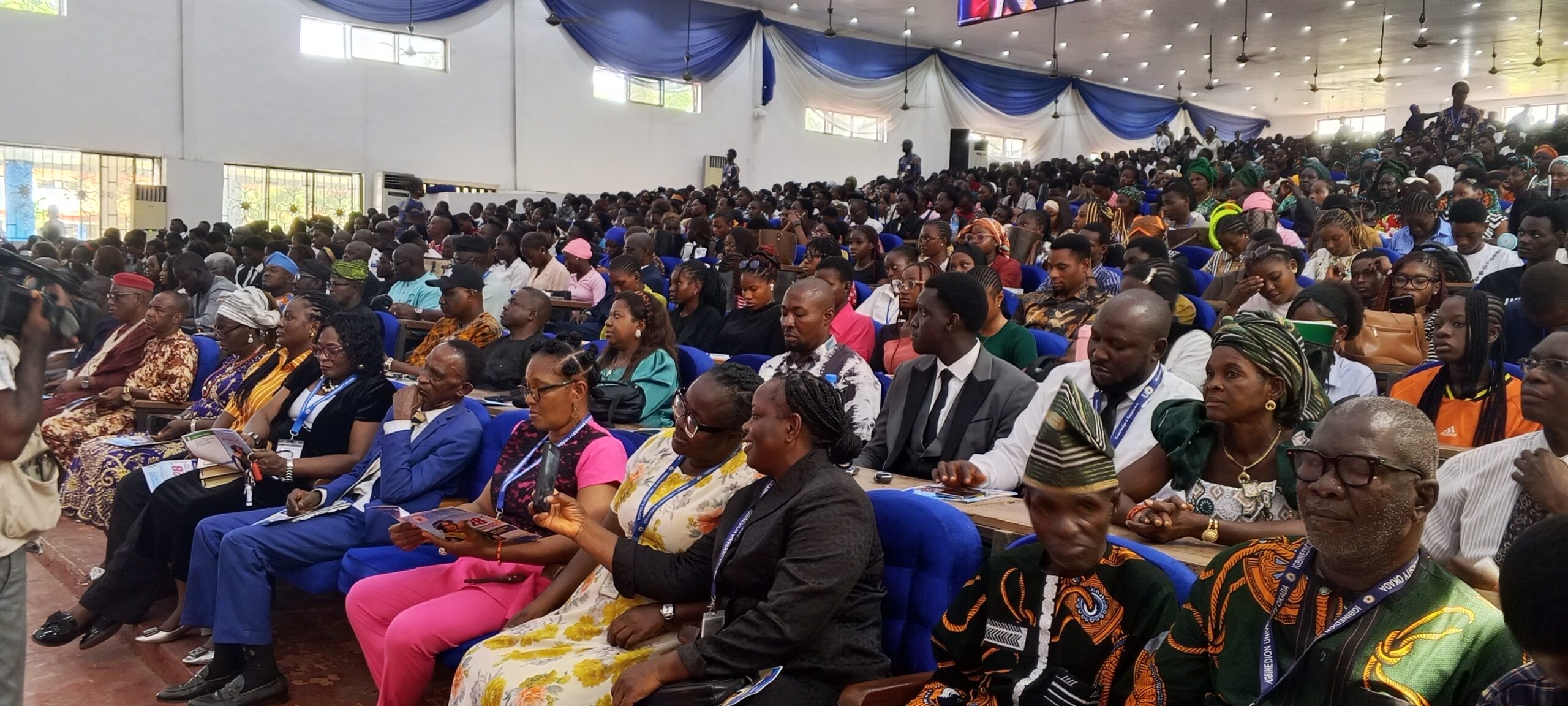
The inaugural lecture, which attracted a large gathering of members of the university community and other distinguished guests, was well received, with participants applauding the presentation and commending the lecturer for her scholarly contribution to the discourse on Nigeria’s fiscal federalism and development.