
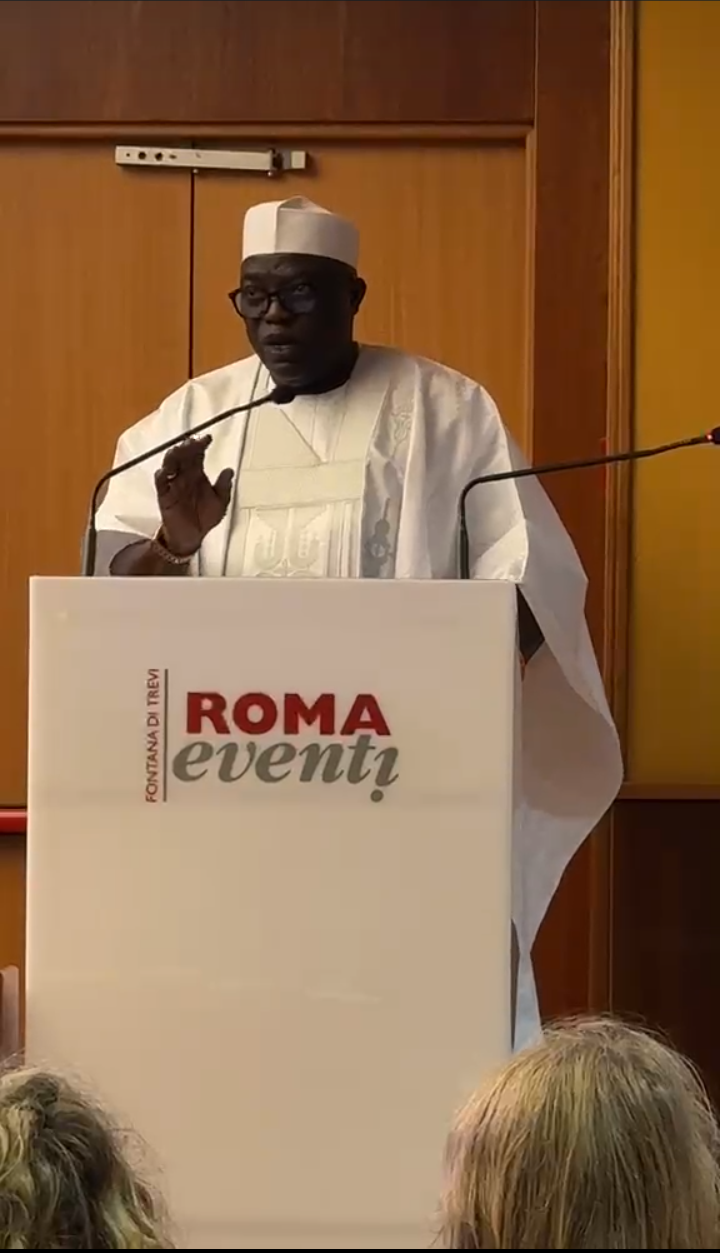
Senator Neda Imasuen has challenged the global economic order that allows resource-rich developing nations to export raw materials cheaply while importing finished products at significantly higher prices, warning that the imbalance fuels unemployment, poverty and migration.
Imasuen, who represents Edo South Senatorial District in the Nigerian Senate, made the submission while delivering a speech as an Honourary Guest Speaker at the Golden Rule Summit Roma 2026 in Italy.
Speaking on “The Golden Rule as a Principle from a Legal and Legislative Perspective: Advancing Development for Underserved Communities,” the lawmaker argued that the principle of treating others as one would wish to be treated must extend beyond personal relationships to international trade, economic policies and government legislation.
He questioned the fairness of an economic system in which countries that produce valuable agricultural and natural resources often derive less benefit from them than wealthier economies that process the materials into finished products.
Using Nigeria’s cocoa industry as an example, Imasuen noted that cocoa is cultivated in commercial quantities in the country but is exported to developed economies, where it is processed into chocolate and other products that Nigerians must subsequently purchase at considerably higher prices.
He argued that establishing more processing and manufacturing industries in Nigeria would enable the country to capture greater value from its agricultural resources, create employment and improve living standards.
“If chocolate factories were established in an industrial State or an agricultural State,” he asked, would the development reduce economic imbalances, lower unemployment and ultimately curb irregular migration and human trafficking?
The lawmaker stressed that the argument was not intended to absolve Nigerian leaders of responsibility for domestic economic failures but to expose the structural inequalities embedded in international economic relationships.
He maintained that global trade arrangements must be examined to determine whether they deliver equitable benefits to producing countries and their disadvantaged communities.
Turning to Nigeria’s legislative response, Imasuen highlighted measures he said were designed to expand economic opportunities, improve access to education and support businesses.
He cited the Student Loan Fund, which enables eligible students to obtain financial assistance for their education and upkeep, with repayment tied to their graduation and subsequent gainful employment.
The senator also pointed to tax reforms aimed at supporting small and medium-sized enterprises, noting that qualifying businesses benefit from tax relief and exemptions under certain provisions.
According to him, such measures can help reduce the financial pressures on businesses, encourage entrepreneurship and create an environment in which more Nigerians can participate in economic development.
He further highlighted the Federal Government’s efforts to improve the business environment and attract industrial investment, citing the Dangote Refinery as an example of a major industrial enterprise established in Nigeria.
Imasuen also referenced government initiatives targeting illegal migration and human trafficking through skills development and opportunities for citizens to engage in productive economic activities.
He argued that addressing the conditions that push people to seek better lives abroad requires more than enforcement measures. Governments must also create opportunities at home through industrialisation, employment generation and people-centred policies.
Apart from economic reforms, the senator warned that laws and government policies must respect human rights and protect human dignity.
He urged lawmakers, policymakers and international leaders to assess the consequences of their decisions, asking whether proposed laws and economic arrangements were fair, truthful and beneficial to the people affected by them.
Drawing on the Four-Way Test of Rotary International, he outlined four questions that should guide decision-making: Is it true? Is it fair to all concerned? Will it build goodwill and better friendships? Will it be beneficial to all concerned?
Imasuen said applying these principles to relationships between individuals, governments and citizens, as well as between nations, would help promote responsible leadership and more equitable outcomes.
He called for stronger international cooperation, fairer trade agreements, ethical governance and legislation that prioritises the needs of underserved communities.
His address placed the responsibility for inclusive development on both national governments and the international economic system, insisting that developing countries must be able to derive greater benefits from their resources while addressing governance failures at home.
The Golden Rule Summit Roma 2026 brought together diplomatic representatives, religious leaders, humanitarian advocates and policymakers to discuss human dignity, peacebuilding, interfaith understanding and inclusive development.
Other prominent participants included Ghana’s Ambassador to Italy, Mona-Helen Kabuki Quartey; Indonesia’s Ambassador to Italy, Junimart Girsang; and former Afghan Deputy Speaker Fawzia Koofi.
Signed:
Moshood Karim
Media Aide to Senator Imasuen