Nigeria cannot develop football from Abuja alone.
The NFF sets national direction. But football itself is made in states, LGAs, schools, communities, clubs, and academies. That makes the state FA the actual site of development, not a formality between it and the national team.
A state FA that exists mainly to attend congresses, run elections, and welcome national officials on tour is not functioning as a development institution. It is functioning as a ceremony.
So, it should be judged like any other institution: by what it can prove, not what it announces.
Every state FA should be able to answer, on demand:
 How many clubs, academies, players, coaches, and referees are registered?
 How many LGAs run structured football programmes, not just one showcase tournament?
 Are there functioning leagues from under-10 to open age, year-round?
 How many girls and women are participating in organised football?
 How many coaches and referees get continuous professional development, not a one-off course?
 Which facilities have been inspected and certified safe?
 Does every affiliated club and academy have a safeguarding officer and a reporting line?
 How much funding came in, where did it go, and what did it produce?
 Where can the public actually see the development plan, the audited accounts, the annual report?
These are not hard questions. They are the minimum evidence any functioning administration should be able to produce.
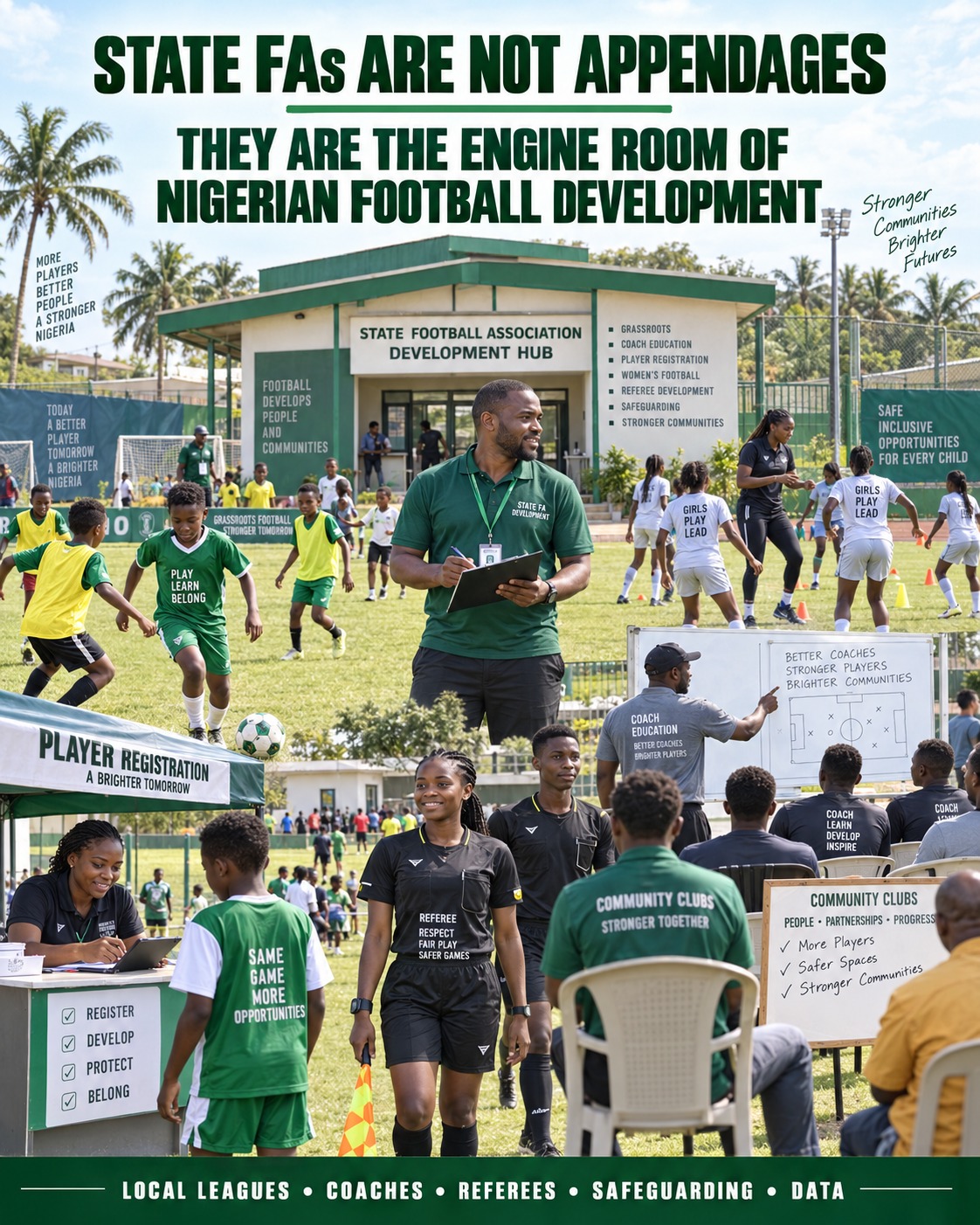
State FAs exist to coordinate local football councils, regulate academies, maintain real player records, develop coaches and referees, run year-round competitions, enforce safeguarding, and connect grassroots talent to a national pathway, in partnership with schools, local government, universities, businesses, and health institutions.
Success is not the number of trophies presented at a closing ceremony. It is participation, player retention, qualified personnel, functioning leagues, safe facilities, financial transparency, and community impact that can be measured, not just announced.
Nigeria’s football pyramid cannot be stronger than its state-level foundation. Weak state FAs hand the NFF poorly prepared players, undertrained officials, fragmented data, and unstable competitions. Strong ones turn talent development into a system instead of a lucky accident.
Which means the reform conversation Nigeria keeps having, “who becomes the next NFF President,” is the wrong conversation to have alone. The one nobody’s asking is: who runs football in each of the 36 states, and what have they delivered?
State FAs are not ceremonial branches of the NFF. Not political platforms. Not election machinery.
They are football development institutions, and if we govern, fund, and hold them accountable, they become the engine room
Nigerian football has long lacked.
So, what has your state FA delivered in the last four years?
Name the programme. Name the location. Name the date. Show the evidence.
Let us assess performance through evidence, not announcements.