

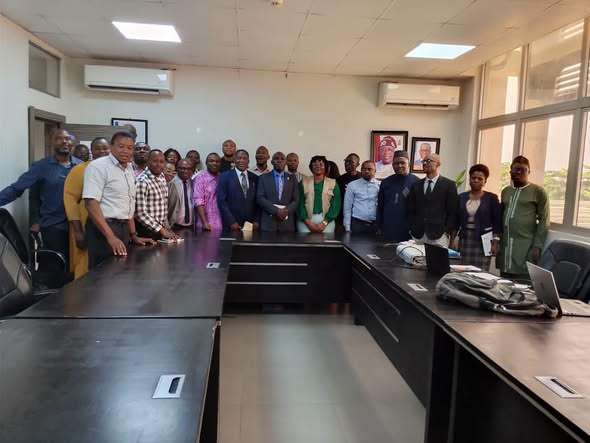
The Edo State Government has inaugurated the Maternal Mortality Reduction Innovation and Initiative (MAMII) Task Force as part of renewed efforts to reduce maternal and newborn deaths and improve access to quality healthcare services across the State.
The Commissioner for Health, Dr. Cyril Adams Oshiomhole, while inaugurating the Task Force at the Conference Hall of the Ministry of Health, commended members of the Committee, including the Permanent Secretary, Dr. Eighemherio Paul Ikhumosa, and directors in the Ministry for their commitment to advancing maternal and child healthcare.
Dr. Oshiomhole reiterated the Edo State Government’s determination to ensure that no woman dies from pregnancy or childbirth-related complications, where every newborn is given the best possible chance of survival through improved healthcare services.
Presenting a review of the Edo State MAMII implementation work plan, Mr. Osagiede Afuwa highlighted the major causes of maternal deaths to include delays in seeking medical care, delays in reaching healthcare facilities, and delays in receiving appropriate treatment. He explained that interventions are currently being implemented in four priority local government areas (LGA), namely, Owan East, Esan South-East, Etsako East, and Igueben, to improve access to quality maternal healthcare services.
Mr. Afuwa identified the shortage of healthcare personnel as a major challenge affecting the programme and stressed the need for continuous capacity building, stronger community engagement, and sustainable management of health facilities. He disclosed that the Edo State Government in collaboration with the Corona Management System, is implementing a Rural Emergency Transportation System to enable pregnant women and children access emergency healthcare services without incurring out-of-pocket transportation costs. According to him, training for the initiative is already underway in Owan East LGA.
A member of the Corona Management System, Mrs. Dorcas Joel, outlined key indicators for improving maternal healthcare to include functional Basic Emergency Obstetric and Newborn Care (BEmONC) and Comprehensive Emergency Obstetric and Newborn Care (CEmONC) facilities, emergency transportation systems, and strengthened community health interventions. She disclosed that Edo State has recorded significant progress, with health facilities in Ubiaja achieving approximately 75 per cent of the required performance indicators.
Mrs. Joel revealed that between October, 2025, and March, 2026, Edo State made measurable progress towards achieving the objectives of the MAMII programme across the participating LGAs. She added that the National Health Insurance Authority (NHIA) recently conducted an assessment in Ubiaja to evaluate the programme’s impact.
The Director of Medical Services, Dr. Edward Aisowieren observed that many rural communities across Nigeria continue to experience inadequate emergency medical services due to the shortage of standard ambulances. He called for increased investment in emergency response systems and healthcare infrastructure to improve maternal and newborn survival rates.
The engagement reaffirmed the Edo State Government’s commitment to strengthening the healthcare system through strategic partnerships, enhanced emergency response mechanisms, and expanded access to quality maternal and newborn healthcare services across the State.





gy8ymf
3frkh3