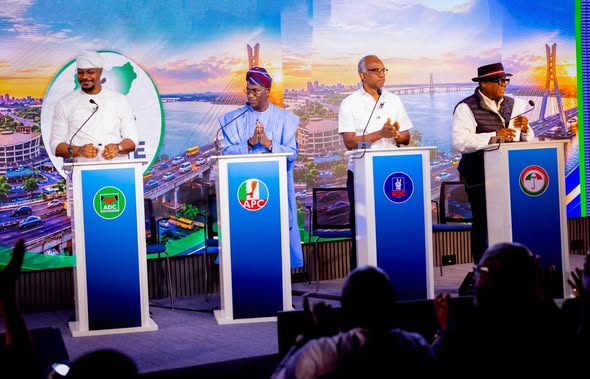
Governorship candidates of four political parties in Lagos State have presented competing visions for the state’s future, sparring over infrastructure, climate change, revenue generation and economic development ahead of the 2027 governorship election.
The candidates featured at a governorship debate on Sunday were Obafemi Hamzat of the All Progressives Congress (APC), Gbadebo Rhodes-Vivour of the African Democratic Congress (ADC), Funso Doherty of the Nigeria Democratic Congress (NDC) and Adedeji Doherty of the Peoples Democratic Party (PDP).
Addressing the impact of climate change and recurring flooding in Lagos, APC candidate Hamzat defended the state’s drainage infrastructure, insisting that proper maintenance remained critical to tackling the problem.
“We have a fantastic drainage system in Lagos; what we need is that it is never clogged,” Hamzat said.
However, the debate took a contentious turn when NDC candidate Funso Doherty challenged the debate’s fact-checking team over its assessment of his claims concerning Lagos State’s ₦1.77 trillion internally generated revenue (IGR).
Doherty faulted the fact-checkers for accusing him of presenting inaccurate information, questioning their assessment of the revenue figures he cited during the debate.
In a separate criticism of the state’s economic direction, ADC candidate Rhodes-Vivour argued that Lagos’ impressive revenue generation had not translated into improved living conditions for ordinary residents.
He accused successive administrations in the state of implementing policies that disproportionately favour wealthy residents while leaving the needs of low-income earners and vulnerable communities inadequately addressed.
The debate provided a platform for the candidates to outline their policy priorities and challenge the records and approaches of successive administrations as political activities gather momentum ahead of the 2027 election.
With infrastructure, flooding, revenue management and the rising cost of living dominating public concerns, the candidates face the challenge of convincing Lagos voters that their respective programmes can deliver meaningful improvements in the state.